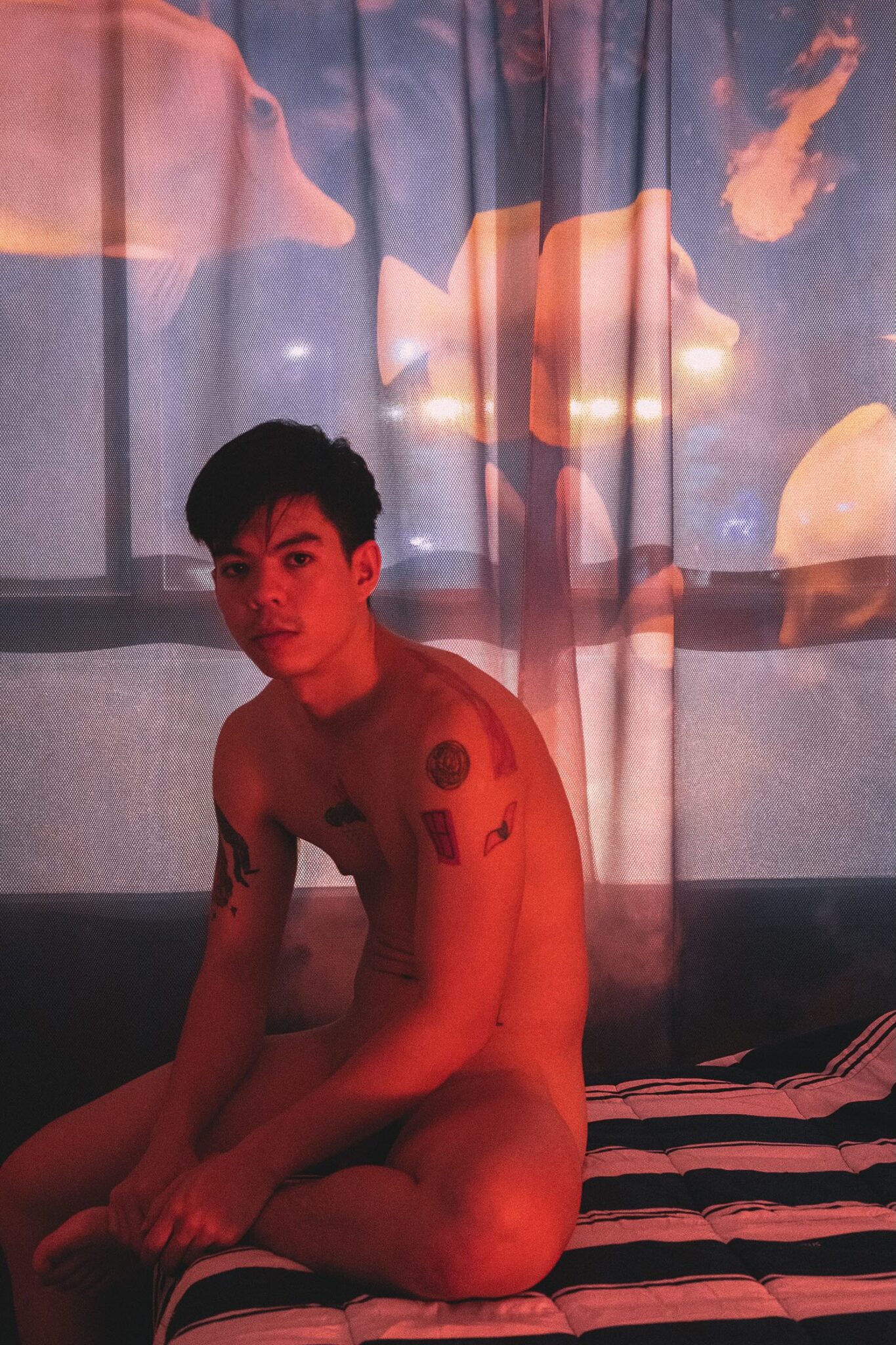
Harit Srikhao
RADICAL FANTASY
Bangkok! I'm inching through traffic in the humongous city on my way to the studio of artist and photographer Harit Srikhao. Even Google Maps can’t find his place on the outskirts of the Thai capital, but after a few phone calls between the taxi driver and Harit, I finally arrive at his hidden oasis, a charming bungalow surrounded by trees. Harit’s work cleverly mixes personal, technological, sexual and especially political realities into an aesthetic orgy. I first spotted the 28-year-old’s mesmerizing photography in The New Yorker and I had to get in touch.
Jop: Where are we? Is this still Bangkok?
Harit: This is my studio. We’re actually very close to the center. Only a 30-minute drive. But the traffic jams are a real problem, especially so in Bangkok.
It feels quite unique that you have this LA-style bungalow here. Being outside and living closer to nature.
I hate airco.
Yeah, me too.
(loud bird calls)
And you make your work here, outside on the porch?
Yeah. I have different work zones. Some outside, some inside. Now, I’m working on what’s gonna be like a graphic novel.
Is the whole house your studio?
Yes, but I actually don’t live here. My home is in another province called Pathum Thani.
Oh! So you live here during the week? Or how does it work?
Yeah, maybe I go home during the weekend. But right now, I just sleep here.
Is it common for Thai people to return to their parents? You’re 28, right?
Yes. This is pretty normal. For example, my mom right now, she’s going back to live with her parents. In Thailand, we don’t have nursing homes like in Europe or in the States. So we have to take care of our parents when they get older.
Let’s talk about your work. You’ve been doing photography for a long time, from a very young age, no?
Oh, you researched me? (laughs)
Of course!
I started doing photography in high school, when I was 14, 15. Mostly pictures of my friends and, you know, family – the classic way to start photography. But then a bit later on, I started to experiment with a more conceptual approach. Responding to the political climate at the time. This was around 2010. Those early works spoke about the mechanism of propaganda in Thailand. I come from a middle-class family and at the time, I didn’t immediately understand the political unrest, the protests of the Red Shirt movement, like, ‘Why are these protests happening?’ When I started university, in 2014, there was a military coup. In my life I’ve witnessed two coup d’états. This isn’t normal.
Definitely not. When was the first one?
The first coup happened in 2006. I was very young, like 10 years old. There are a lot of things we weren’t taught in school, like the relationship between the monarchy and the military. The coup helped us students become much more aware that our minds and our bodies were under the control of this group of people.
The military?
Yes. And the monarchy. It’s still illegal to critique the king. King Rama IX was a good political figure. He knew how to play the game. But after he died in 2016, his son Vajiralongkorn, he is, you know… (laughs)
Yeah, we all know! The “crop top king”.
When he came into power, people were like, ‘Whoa?’ With the rise of social media people accessed information that was different from the official government-controlled news sources. Information that they couldn’t access before. It was game-changing.
People grew more skeptical of the monarchy?
It became very normal to talk openly about politics and the monarchy. Everyone has always known what’s going on. But in terms of political change, it just never happened.
What’s the change the Thai people want?
(dog barking)
The reform movement was very strong before COVID and it looked like they were going to win. But unfortunately the pandemic and lockdown broke the movement and nothing changed. What the movement wants is for the king to be under the law and for all his financial activities to be transparent.
It’s quite a shock for a tourist that Thailand is a military dictatorship. Is that the right thing to say, or is that an exaggeration?
It’s the right thing to say.
And it’s a democracy at the same time.
Supposedly so. But the military and the monarchy share the real power, not the parliament.
Were you involved in the democracy movement and the protests?
I attended a couple of rallies. We had lots of young people and students that really put themselves at the front. A lot of them have been exiled from the country.
A lot of queer people too, I read. What would happen if they returned to Thailand?
They can’t.
They can’t?
No, they can’t.
Oh, wow. Where are they?
Some are in France, some in Japan. Some in New Zealand. According to the official news, if they are in the country, they go to jail. But the rumor is, if they do come back, they risk being killed.
From the outside world, as you probably know, Thailand is seen as this super liberal place. A gay mecca. Known for prostitution and massage parlors literally around every corner. How is it in reality?
The government is okay with this image of the country because it makes a lot of money.
Homosexuality makes money?
Yeah.
Or do you mean prostitution?
(loud bird calls)
I think both. Like for example, gay films and gay TV series became a huge industry in Thailand. But gays and sex workers don’t have rights. They aren’t protected by the law. Prostitution is still officially illegal and we don’t have same-sex marriage like how most of Europe does. If you have a Thai boyfriend and he dies in the hospital you have no legal rights to see the body or sign the death certificate.
And that probably happens frequently.
The government doesn’t believe in human rights.
How was it for you to come out as a gay person?
The awareness of sexuality in society didn’t really happen until the student protests in 2019. The political awareness happened at the same time as the awareness of different forms of sexuality. Not for me personally, but in general.
It really shook up society in every possible way.
Yeah. Before that, it would’ve been very hard for me to tell my parents that I had a boyfriend. The student movement was an awakening for the whole society. We can finally speak about what has been hidden.
And now you see, for example, that your bachelor uncle is gay?
Actually, a lot of older men came out after the protest movement.
Oh, really? That’s beautiful.
It’s very beautiful, also in political terms.
You told me your mother is a stewardess, which is often seen as a very worldly and open-minded job.
Yeah. I think she actually understands that I’m gay. My father, I don’t think he really cares what I am. Maybe he experienced, I don’t know, bisexuality in his teenage years?
At what age did you have your first boyfriend?
20, 21, when I was in art school. In high school, I had a girlfriend.

Did you always want to be a photographer or artist?
Making pictures is the only thing that I’ve wanted to do. The camera is this very powerful tool. Ultimately I want to be a filmmaker. Like, to tell a story with images.
There’s something unsatisfying about photography, in a way it’s generic as a medium. It’s difficult to put a personal stamp on it or to create something that has a surface.
Well, people should see me in the darkroom printing images for three hours. (laughs)
Whose work would you look at when you were a student?
Actually, Nan Goldin. I think her imagination is so pure, and very intense. It’s not common in Thai culture to photograph or show something very intimate. Like people doing drugs or having sex. That was very new and exciting to me.
That raw quality is very different from your work, which is more dreamlike, a fantasy.
You can be honest with fantasy. What I like about Nan Goldin, and Wolfgang Tillmans too, they always have some sort of very sincere, very honest and very personal thing in their work. It’s not just a photograph by anyone of anyone. You can feel them, it’s like having a conversation. That’s what I want.
I’m attracted to your work because it’s so different from anything else that’s contemporary right now. When I first saw your work in The New Yorker – a portrait of Thai film director Apichatpong Weerasethakul sleeping while surrounded by flashes of light – I was like ‘What an interesting image, who shot this?’ I was fascinated.
I photographed him with this technique I’ve used since high school. It’s just a flashlight pinned to my body. I paint the picture with light.
You use this old lighting technique to create something that feels fresh. It’s transformative. That can’t be done by always producing exactly the same images, which is so often seen. You need to experiment, right?
This moment in time is especially exciting. You have, for example, AI generators that can create images that are very photographic. You don’t see the difference between a photograph and an AI generated image anymore. Everything has become an image.
Let’s talk a bit about your ‘Bangkok Wet Dream’ project. How did it start?
It started as a collaboration with the brand IWANNABANGKOK, as a response to the student movement we spoke about earlier. We wanted to do something that in a sense was popular and accessible, but provocative and political at the same time. We wanted to create images that everybody would clearly understand, mixing different visual languages, cartoon, fashion, religion… It’s fun and light while questioning the authority of policemen and the military.
You’re objectifying them, right?
Yes.
Which in a way disempowers them?
Yeah. So we treat them like an object because they treat us like objects. The exchange is fair. At the same time we use masculinity to make an image that girls and women would like.
That every gay man would like!
Yeah, but we focus more on women.
Oh, really? (laughs) Even with the imagery of dripping cum?
We want pretty girls to wear the product. The images are printed on clothes and towels that we sell. We really like that idea of people using and wearing the images. It’s like using a police officer to dry you off after a shower. And we produced a skirt for girls that has an image of a policeman sniffing his shoe. It’s very satisfying to see people interacting with it. (laughs)
What is the Thai standard of masculinity?
It’s changing. I think these masculine, brown-skinned men that are in ‘Bangkok Wet Dream’ are in a way sex symbols of the past – Thai boxers, soldiers… Right now the white, clean Korean man has become very popular. Especially because of all these Korean TV series. They don’t represent masculinity in that traditional way, but more of a masculinity that’s like Timothée Chalamet in ‘Call Me By Your Name’. This has become the model for teenagers.
And there are, here in Bangkok, so many perfect looking teenage boys in media – on billboards and screens just about everywhere.
It’s huge. Perfect white teeth…
All the boys look like they’re 17 or 18. And they’re completely manicured and photoshopped.
They’re actually closer to my age, but they are manipulated to look younger. I think it’s very interesting. Almost like science fiction.
I’ve noticed that there’s an easiness in Thai culture. The concept of “sanuk”, everything should be enjoyed, everything fun. That’s real, right?
Unfortunately, it’s real. (laughs)
Why do you say unfortunately?
Yeah, because “easy” and “fun” don’t make for successful political change. We are too laid back. We make fun of the monarchy, but what we should really do is demolish it.
Right.
Thai people like to have fun and maybe society pressures us to have fun. I love to have fun too, but life can’t be fun all the time. Especially when so much change needs to happen.
But at least the sun always shines.
Yeah, except when it’s raining.


Originally published in BUTT 33