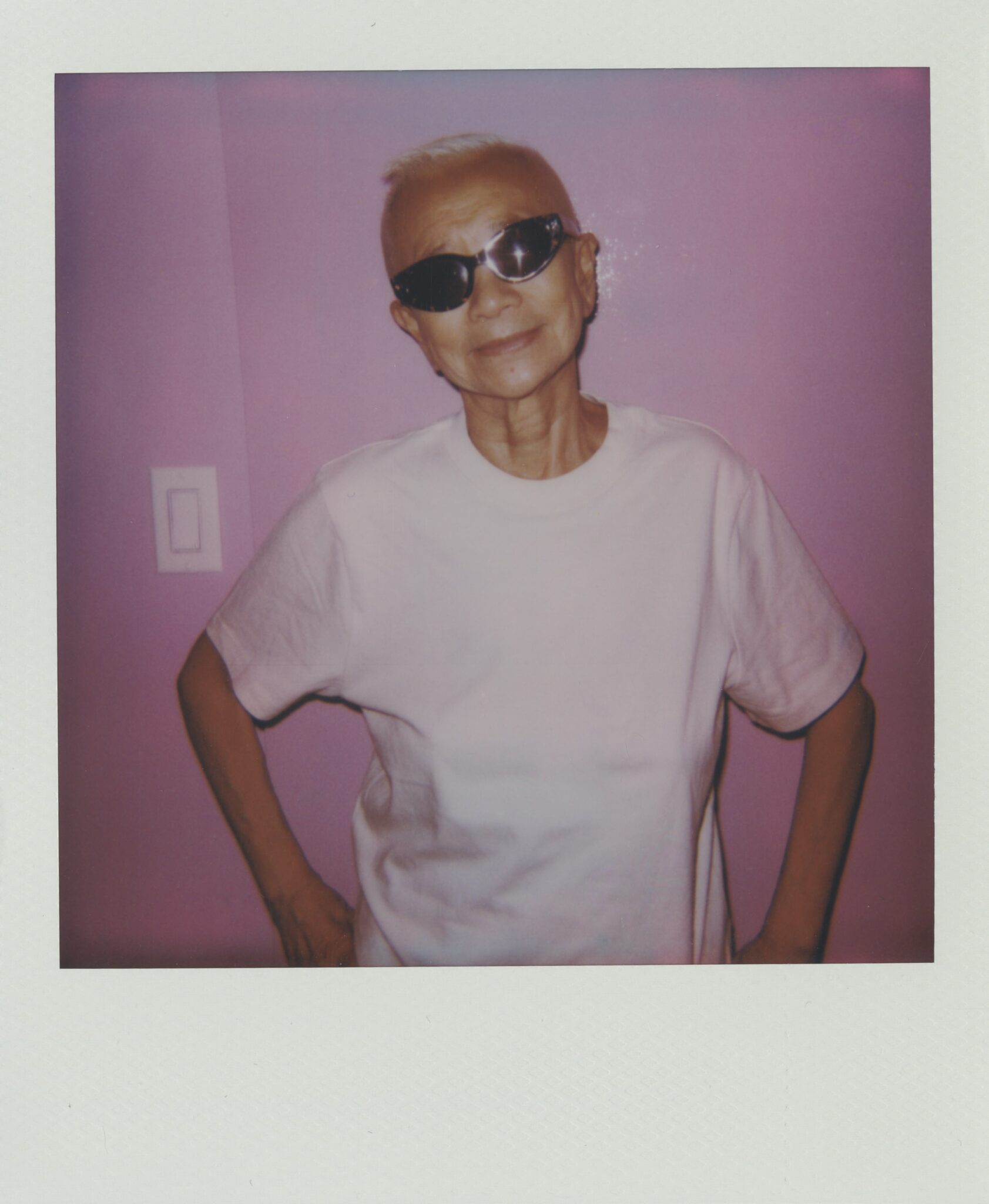
Shu Lea Cheang
Sci-fi pornographer
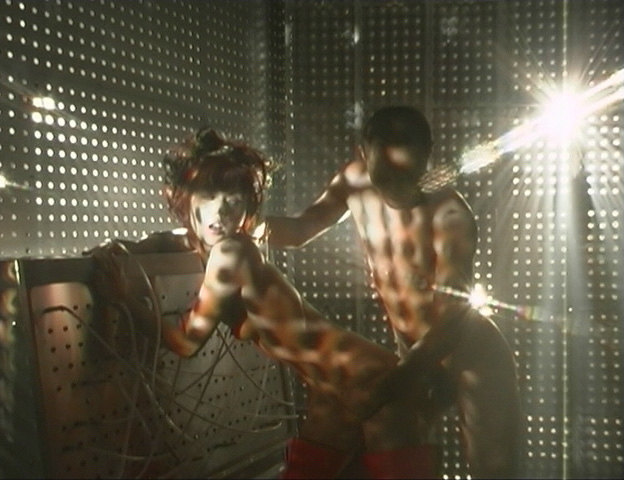
Taiwanese-American artist Shu Lea Cheang broke out with her first feature film ‘Fresh Kill’ in 1994, while she was living and working in New York’s Lower East Side. The film pioneered a new genre of sci-fi “new queer cinema” which Cheang has been working in ever since. In 2000, she released the film ‘I.K.U.’ — a hardcore reimagining of Blade Runner — in which shapeshifting cyborgs collect “orgasm data” from residents of New Tokyo through penetrative sex. Legend has it 40 percent of the audience walked out of its Sundance premiere. Today, Shu Lea is still in the middle of it, and we caught up in a tiny pink office at the Leslie-Lohman Museum, where her latest installation ‘LOVER LOVE’ is currently on view. It’s a fittingly dreamy tribute to her late friend and collaborator Aérea Negrot, featuring ritualized BDSM scenes and even a flying green dildo. Cheang kept her sunglasses on as she told me about New York in the 90s, and laughing through grim times.
Max: So you haven’t lived in New York since 1999, when you moved to Paris. How does it feel to be back?
Shu Lea: I come back for work from time to time. Of course, it took me a long time to overcome the changes that have taken place. I used to live on Bowery, so you can imagine. To actually walk through the Bowery now… for a long time I refused to walk through there.
Yeah, it’s definitely not the same street as it was in the 90s. Are there particular spots that you miss there?
Well, the apartment I lived in was between 3rd and 4th Street, and at the time, on 4th Street there was Bowery Bar, where Nan Goldin used to hold court. She got a very good deal because of her photography, they let her dine there for free and invite friends. The only thing we’d all have to chip in for was a big tip! (laughs)
I would have loved to have seen that, the 90s were such an iconic moment for the city. I bet it was quite the scene.
Oh yes, it was a beautiful time. There were lots of spots in the East Village. You could be dining quite late, go to the party, and you know… it was a lot of fun.
I can imagine! Is there anywhere that’s left that’s still familiar?
Oh! The good thing is there are lots of Chinese kitchenware stores that are still there. Otherwise, it’s pretty much all changed.
You’ve been making work about gender and sexuality for decades. What was the attitude in New York towards that when you were living here?
I think in the 90s, when I was making my first feature film ‘Fresh Kill’, that was during the boom of the so called “New Queer Cinema,” so you had André Téchiné, and Rose Troché who made ‘Go Fish’, for example, but it was still much more “Gay and Lesbian” — very binary. All the gay boys would only go to gay films (laughs), it was really defined by gender. By the time I made ‘I.K.U’ in 2000, I brought a lot of different types of sexualities into the film. I have never felt limited to these binary gender restrictions, or the kind of gay and lesbian sense of a “boy’s a boy”, and a “girl’s a girl.”
When did that start to change?
In 2000 in the very beginning, Paul B. Preciado started showing my films and I was quite affected by his writing. Then of course, we worked together in 2019 when he curated my show at the Venice Biennial. I had moved to Paris and he came to see me, and then later when I had the chance to recommend a curator to work with me, I brought him in, and that was a…very intense working relationship (laughs).
Okaaaay! Can you tell me more about that?
Oh you know, we got very involved. I came out with the idea, the exhibition space was a prison that used to house Casanova. Everyone knows Casanova as a great lover, but I dug deeper into that story and decided to explore the idea of sex in prisons, and the people who were incarcerated for reasons related to sex and gender. So I found 10 different characters who were imprisoned, including Michel Foucault.
I didn’t know Foucault was imprisoned.
See, almost no one knows that, but he was put in prison in Poland for a year for being gay. He actually had a teaching professorship there, and was tricked into admitting he was gay. They sent someone to seduce him, and my film kind of explores that story.
Did immersing yourself in these worlds and making so much work about gender and sex change your relationship to your own identity?
Well, you know, in terms of my own sexual approach there are multiple threads, let’s put it that way, so I’m not a lesbian, I’m a queer. I’ve had to make that very clear. So in this sense, the trans man or trans female or more, like, non-binary, I’m totally in the middle of it.
Is that reflected back in your work?
When my film ‘Fluidø’ came out in 2017, my agent told me it would be difficult to sell because it was not strictly “Gay or Lesbian”. By the late 90s I had started really digging into trans issues. I went to San Francisco, and then to Amsterdam to study trans medical treatments, as there were many surgeries being conducted there. So by the late 90s I was really into trans ideals and issues. Very sadly, this particular work at Leslie-Lohman also focuses on the fragility of trans life, triggered by the death of a trans person.
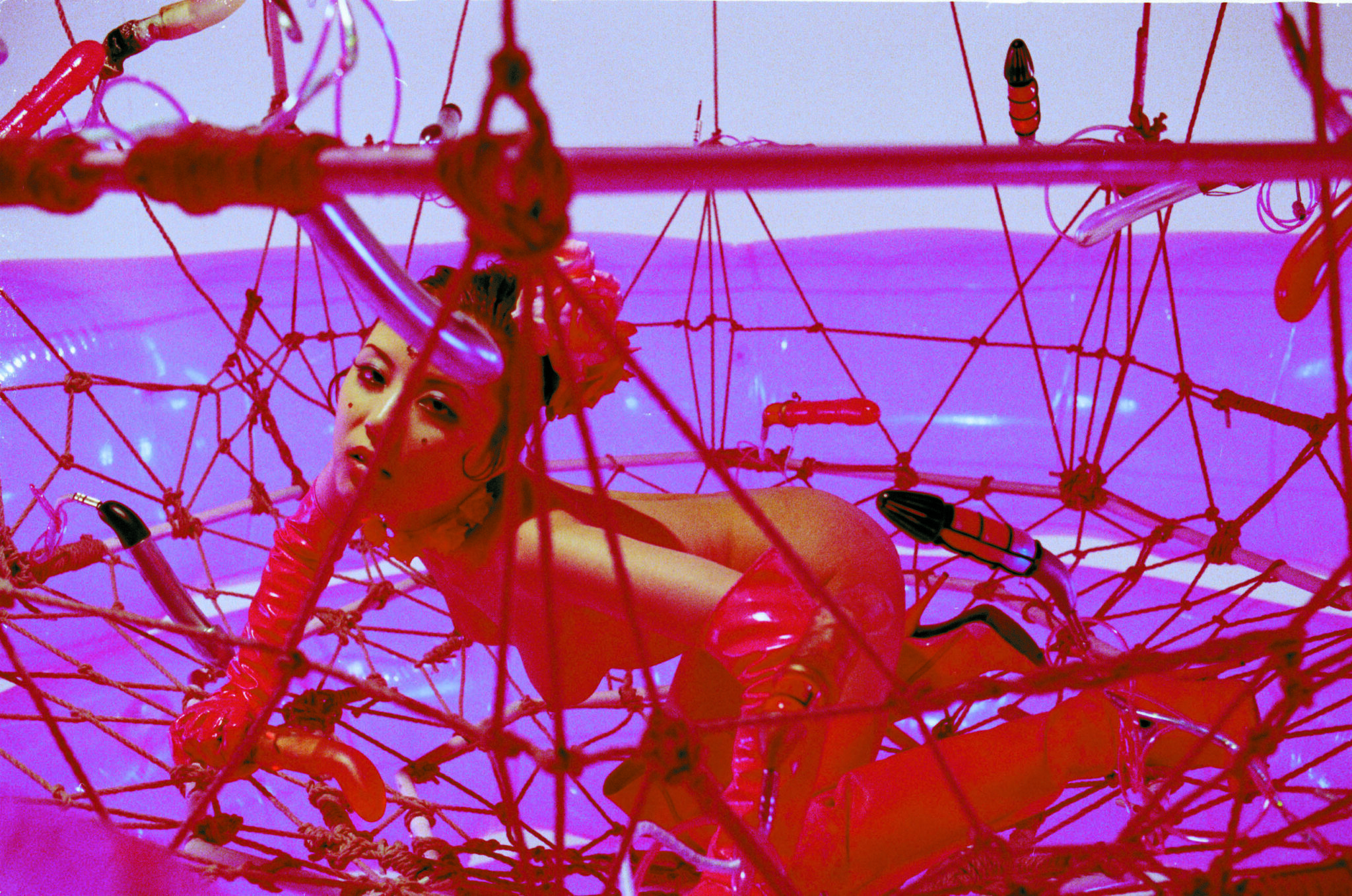
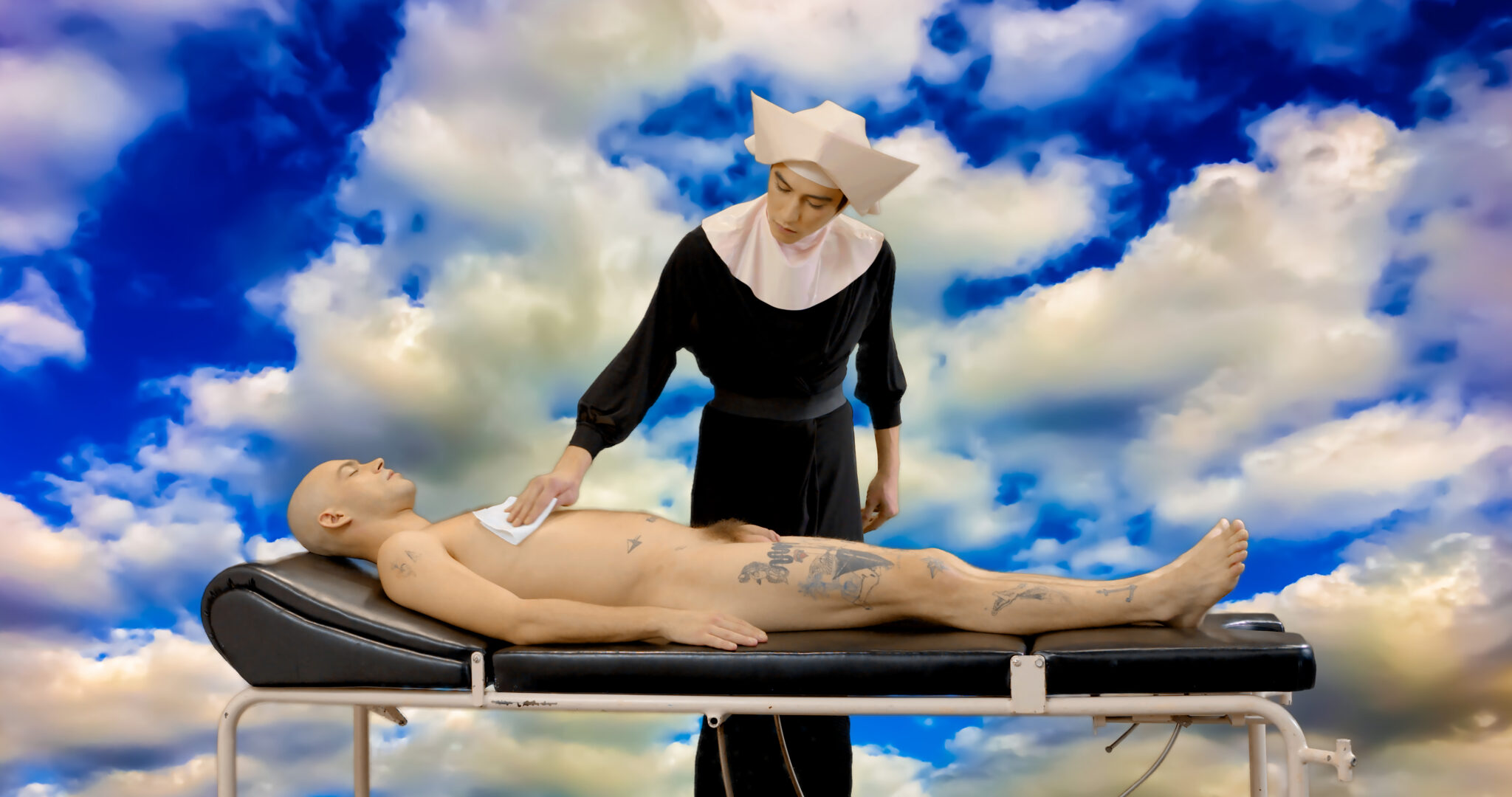
Yeah, let’s talk about that. ‘LOVER LOVE’ is in many ways a beautiful tribute to your friend Aérea Negrot, who died by suicide in 2023. You’ve said before that you actually think she wasn’t trying to hurt herself, she just thought she could fly. I know you two had a professional relationship, but am I right in thinking you overlapped personally as well?
I first met her in a theater, I was looking for a performer for Fluidø, so I went to see her performing in a theater space in Berlin, and decided to cast her for the film. I later found out she was also a DJ and wrote songs, and talked to my producer to see if we could try her out as a composer for the film. We did an official interview with her, and she came in totally drugged (laughs).
How was that?
It was so… I just remember this scene — she told us she was sick, that she had a cold, so she had this drop thing, like you might have for a sore throat, and throughout the interview she kept dropping this into her throat. She was a big user, I think she was nervous. I would go to her studio to work with her on the music, but she would come up with such unusual music compositions and there was a point when I realized, you know, I can’t judge anymore, so would just say to my producer, “you go talk to her.” You know, she was going through it the woman was totally out of her mind…it was a process. So, of course, we collaborated several more times.
It’s a pretty involved installation with the four floor to ceiling screens that the viewer is meant to push around.
There are several meanings to that part of the installation. Of course, when you move the screen you are moving the screen away from the projected image, and that is meant to reflect the sense of pushing trans people out of the spotlight. And in the exhibition it also triggers Aérea’s song, her memory. When we first tried to realize it the technical person insisted on talking to me because he wanted to make sure that I understood the chaotic situation I was creating, to make sure that I wasn’t crazy.
Something I love about your work is that you talk about quite serious and urgent topics, but you always find ways to include moments of unexpected humor — like in LOVER LOVE, a giant green dildo unfurls on the screen and flies around like an angel (both laugh). How do you bring levity to what are often quite dark topics?
The political moment is always so grim and there is so much repression and anger especially today my films are a way to look for release. I look at America and I feel the repression is very grand. At the end, this project is kind of a response to the trauma of two-sex-slash-two-gender America. So, in a way, it is really also provoking that particular conservative America, and within this you know…you just have to laugh.
Agreed. On that note… how do you feel about laughing during sex? Are you pro?
Laughing during sex?!
Yeah, some people really don’t like it!
I have nothing against it, I think sex is pleasure seeking and laughter is a different expression of that. Earlier this week we screened my film ‘I.K.U.’ at Nitehawk Cinema, and I was explaining how the title is actually “iku,” the Japanese word. In Japanese, sexually, to express that you’re cumming you say “iku iku iku,” which literally means “I’m going.” So it’s more like do you contain the pleasure of the ejaculation, or do you imagine that you are actually going out to another paradise or whatever. Of course, in the process of arriving, you should be laughing.